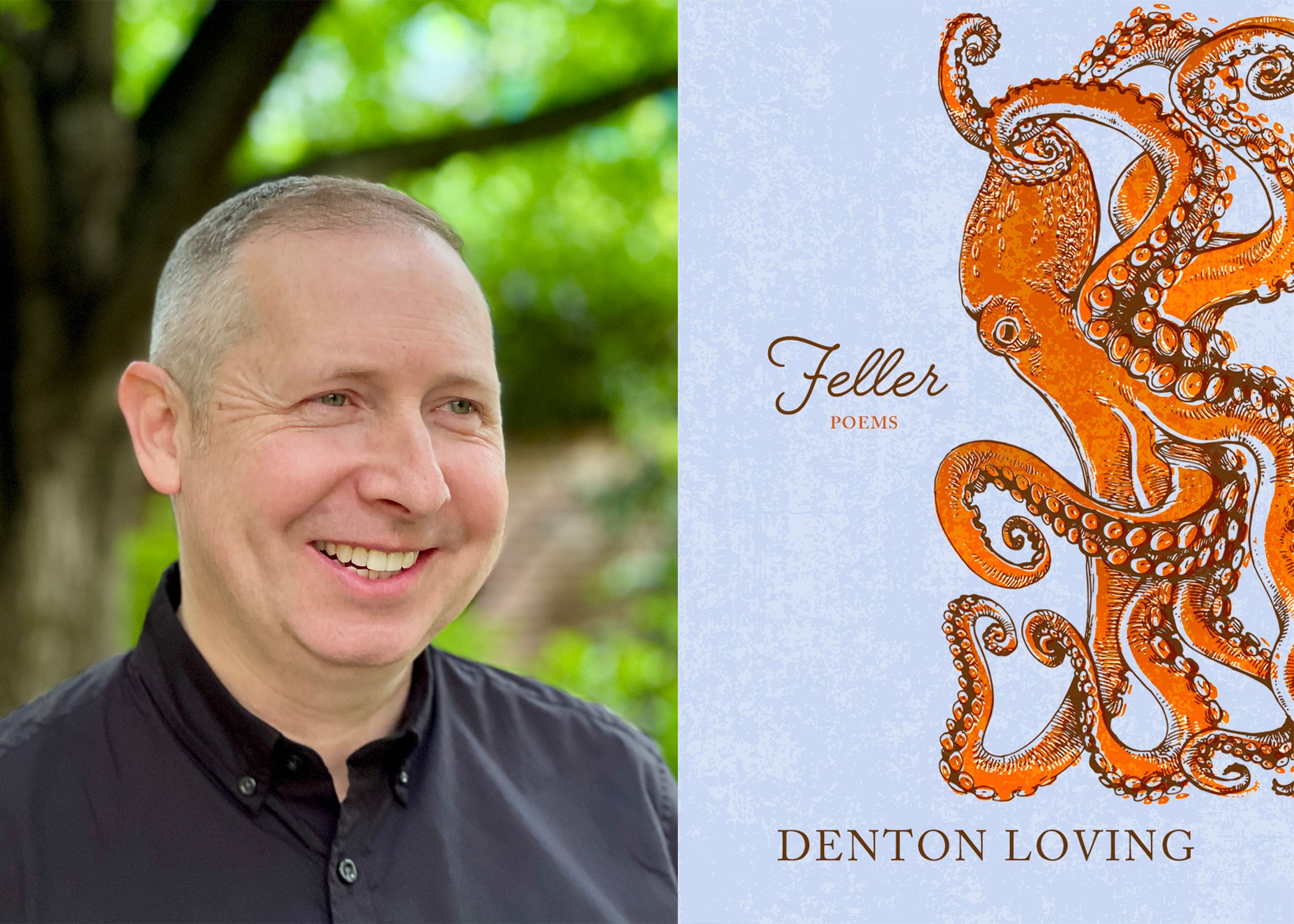
Lacy Snapp: In an interview with The Beat Podcast, you spoke about how you were writing Tamp and Feller simultaneously, and that you would write a poem and see it either as something that fit into the Appalachian father narrative of Tamp, or as belonging in Feller. Knowing you as a poet and a person, it’s interesting and strange to read these two books in tandem. Both contain an attention to wonder, perhaps as any poem does. But, it feels like Tamp falls into this external Appalachian identity or narrative expectation, and Feller is everything else—the inner layer of intimacy, magic, whimsy, and the exotic—that our identity is not limited to one landscape or sense of self.
You and I have talked about this duality before, which is probably best represented by the poem “Returning.” I also see it in the poem, “My Spirit,” in the speaker’s ability to stretch and snap back. I am wondering if you’d speak about this concept a little bit, especially as you’ve been reading from both of these books now. In doing so, are you able to see your sense of self as almost split, in a way? Or how do you see it? And what did the process of writing these two books reveal to you?
Denton Loving: That’s a great question. I don’t know if I would say split is the right word for how I see myself, or how I see the way that these two books play against each or with each other. It might be an accurate word, but it’s just not the way I think of myself. I will say that one of the thoughts in this process, especially towards the end of Tamp, is when I realized it was going to be a book and that I had a lot of poems that would eventually be something else. I knew I had written a lot of poems about home and my family. All of that includes the region. I knew that I was also writing poems that were looking outward, and not just inward. I mean that in a personal and geographical sense. I think with a poem like “Returning” that addresses the acknowledgement of having one foot in one place and one foot in the other. With Feller, I gave myself a lot more freedom to go ahead and take that step outward a little bit more. It wasn’t hard, but I think after really looking inward and thinking a lot about my dad and my family’s place within the region, I was ready to try and explore some new ground.
LS: I like the idea of you looking inward to write Tamp, and now being able to take that step outward in Feller. There’s a phrase from “Lake Sagatagan Summer” that says, “Who we were / before the other existed as witness.” I was thinking about that line when considering this sense of identity. I know in that poem, we are talking about two people in a canoe that are in conversation, but what if it could be a person saying that line to the self? It’s as though the first self who existed became witness to the later self, and yet somehow both of them are authentic. Who were we before the other existed as witness? Is the grounding of the self in Tamp the necessary foundation for being able to witness that outward step that you’re talking about, the freedom that you were able to have in Feller?
DL: I love that reading, or that view of that line in that poem. I can’t say that I’m smart enough to have been thinking in that vein, but I do think identity is a large part of this whole collection. In that poem, I am playing with the idea, or acknowledging who we are inside, who we are to other people, the way we present ourselves to people, and trying to explore all of those different ways. It’s really hard for us to ever know the truth of who we really are, because our private self is so different from what we present. There’s no real way for us to ever fully present our inner self completely accurately. We get close sometimes, maybe with some people, but in the same way, it’s hard to know if anybody can ever know our deepest secrets, fears, hopes, and dreams. I really love that reading, and I’m glad if that’s there.
LS: I have one more identity question, and it kind of goes with knowing of the self. I felt the sense of breaking through in the collection. When considering this, I was simultaneously thinking about liminality and the thresholds we cross. In the poem “Letter to My Lover as Abraham Lincoln,” there’s the line: “The real question is how I break through the layers / of optical scales to know myself.” You also have another epistolary poem, “Letter to Rilke,” and this is all about the unknown, or it seems to be. It’s like the speaker has particles of knowing.
I’m curious about this poem, especially, and this idea of wanting to know and trying to break through. Then, the connection of that to loneliness. I’m not sure that there’s an answer to this, but I’m drawn to this epistolary poem, and that it in itself is another threshold. I’m seeing this threshold as another place of duality, that we can both know and not know simultaneously as a state of the poetic human condition, as well as how that relates to identity. Was that something prominent for you in this collection?
DL: I’m so interested in thresholds and in the way that the threshold is a doorway to transformation. I think the way that I view this collection, and this applies to “Letter to My Lover as Abraham Lincoln,” is that we don’t learn things about each other until we’re wounded in a certain way. We have to go through some fire to find out what we’re made of. To me, that’s the threshold, where we’re hurt but we come out on the other side. Hopefully, we’re a little better, a little stronger, but we also learn something about ourselves. If it was a really transformative wound, then we become someone different because of it. I think the way both of these poems speak to that is that life for some of us is about trying to figure out who we are. I think there’s a myth about thinking it happens when we are a certain age, like when we’re 18, 21, or 30. I think it takes these life events to happen, for us to make discoveries, and when they happen throughout life. The older I get, the more I realize that there’s still a lot of myself to discover.
LS: I’ve never considered wounds as thresholds, doorways to another state of being. On threads in the book, I also want to ask about birds—I notice many of them in these poems. I know a lot of poets write to birds, or about birds. So I had birds as a lens in “Thirst” and “Chimney Birds,” especially the cardinal and bluebirds at the beginning. We have these birds, which often exist as a lens or a threshold. This is not necessarily a direct question here, but I am curious about your use of birds.
DL: I think when we talk about thresholds, and if you look at mythology, birds are some of the animals that have the easiest way to pass through thresholds. I try to just write organically about whatever it is that interests me, and draw on my experience of what I see or what I read. Like mythology and history, these are places where I can draw imagery and ideas from. I think the birds are always present for me, and always doing some of the work of moving back and forth between places. Places meaning between states of being.
LS: I mean, they do travel between worlds, right? The physical planes, and then the planes of existence. It’s so interesting to think of them as being able to be the travelers when we can’t be.
DL: Birds seem so simple in some ways, but they are inherently magical. Even in the most natural sense, the way that they exist is fascinating. To anybody who’s really paying attention, it’s pretty fascinating.
LS: They’re also so complex, and there are so many different types of birds to study as source material. Truly, they are magical. I think magic and whimsy are a thread of Feller. There is just so much whimsy packed into one book.
DL: I think that’s a great thing to talk about. My second book, Tamp, was primarily about my dad, and most of those poems were written after his death. I did not see it as a book about grief when I was writing it, but that is the way it was received by readers, which I’m thrilled about. It was definitely a very heavy book. I was writing those poems as a way to process my loss. And so, in some of the poems I was writing for Feller, I was looking for opportunities to be more lighthearted and to try to have a little bit more fun. People ask that question, “Why do poems have to be so sad all the time?”
There is something about the poetic form that speaks to grief and pain. I think that is a universal fact that is proven by looking at poetry from any culture, any region, any time period. I also tell my students that it’s really hard to write a funny poem and do it well. I did actively want to write some poems that were just more fun and lighthearted. Not all of them worked, but a few of them made it into Feller.
LS: Regarding tone, I want to ask a little bit about one we haven’t discussed yet from your poem “Thirst.” It has this quote: “When you don’t have water, / it’s all you think about.” There is so much desire in this book. It reminds me of the Rilke poem where it’s this liminal space between wanting and having, which is maybe another threshold. You know what you want, you know what you lack, but the speaker exists within the space of desire rather than having.
I also associate “Breach” with this: “I wanted to dive in, to give myself / to their body of water, / but my guide held me back, reminding me / the ocean we desire might desire us / to live a little longer on dry land.” Same with “Marcescence” and the quote “Strange how even a tree has desires. / Strange how until something new grows, / what no longer serves will cling.” There’s so much desire.
You mentioned once that someone described your book as “a meditation on sex and death.” It might be strange to say that I consider both sex and death as a form of having where I feel like so much of this collection is in the longing, the desire for something. I don’t know if there's as much having that exists in these pages. Do you, or the speaker, think about desire with this book? Does longing persist in the poems?
DL: I mean, longing is the word that I have been using to talk about the book since it came out, but desire is completely accurate. I hadn’t even realized how many times that word is used until you quoted from those various poems. It’s definitely the heart of the book. This book is not about having. This book is totally about longing, and the most apparent thread of that longing is a romantic relationship at the core, but I hope that when readers read the book, they see that longing appear in other ways. What I was thinking as I was writing this is that I’ve come to an age where I’ve lost friends who have either passed away or have simply drifted apart, but you miss the relationship you had earlier in your life, before things changed.
Obviously, my father has passed away, and so I was thinking about that in a different way, maybe a more mature way than the grief that was really much more raw in Tamp. As you referenced earlier, there is this longing for place. For me, that plays out in being in one place and wanting to be somewhere else, and then going to that other place and wanting to be back at the place where you just were. The poem “Returning” speaks to that specifically. But, even just wanting to find where you belong is touched on in some way in these poems. I hope that readers can see all those different threads beyond the romantic relationship that I think is sort of the overall narrative arc of the book.
LS: Saying you miss the relationships you had earlier in your life is interesting because grief in that scenario is also a kind of longing, one in which you’re longing for a past version of yourself—who you were when you were in that relationship. Do you know what I mean? The longing is not just for the other person; it’s also recognizing the self that you were when that relationship was happening is also gone.
DL: Absolutely. This goes back to our previous mentions of thresholds and identity, because what happens when you have a friendship that breaks down is you become a different person. You can’t just recapture and reclaim it. Certainly, that’s true in romantic relationships, but I think it’s true in platonic friendships as well. We all change, we are constantly changing, and it’s hard.
LS: That’s the thing that I was thinking about so much with thresholds in these questions. Even in the Rilke poem: you want to know, but then you know, and then it almost entices another state of wanting to know. It’s as though you cross the threshold, which allows you to see another threshold. Even the state of desire just leads you to more desire.
DL: I think the best analogy I can offer in this way is if anybody has ever researched their family history. If you find one name, then it leads to the question of two more names. So if you know who your grandfather is, then upon finding that out, you want to know who his father and his mother are. If you work to find those answers, then you find four more questions. I think that life, for many of us, is like this. We keep moving forward. It’s such a cliche, but I think it’s true that the more I learn, the more I realize I don’t know. I think that this is also at play in these poems.